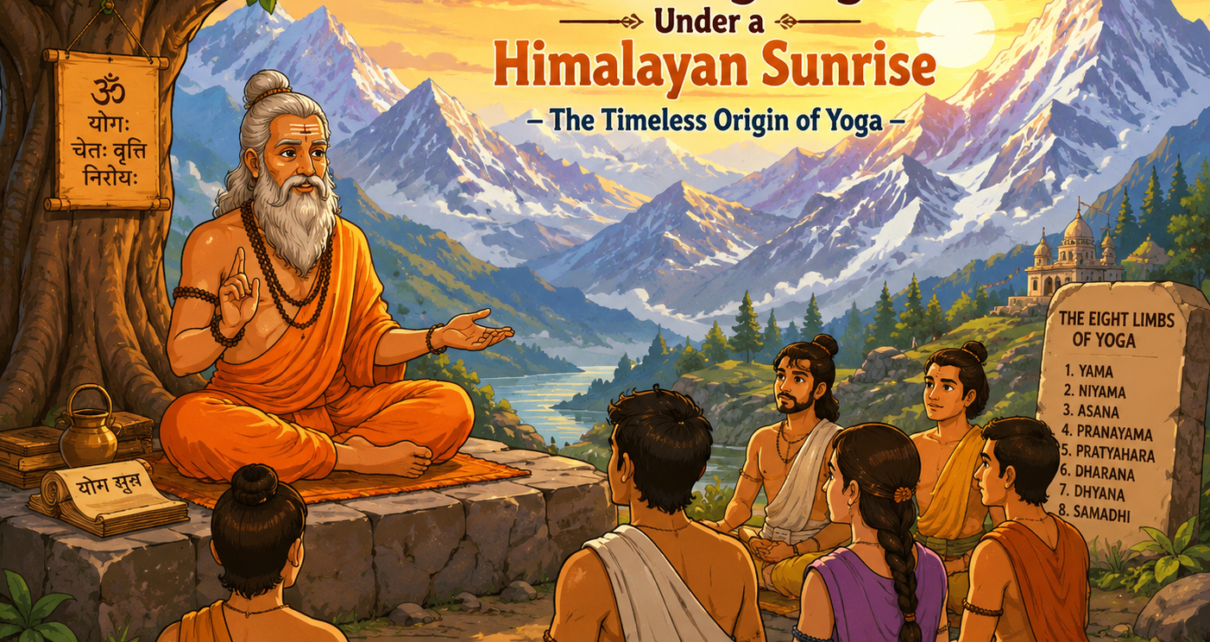
The Ancient Origin of Yoga in India: Timeless Wisdom for Health, Peace, and Spiritual Awakening
“I bow to the eternal lineage of Yogis who discovered the science of inner transformation long before the rise of modern civilizations.”
Introduction: The Eternal Gift of India to Humanity
Dear Seeker,
I welcome you to the sacred path of Yoga.
Today, millions practice Yoga across continents. Some seek flexibility. Others seek fitness, weight loss, stress relief, or better health.
Yet Yoga was never merely about stretching the body.
Yoga is one of humanity’s oldest sciences of self-realization.
Born in the sacred land of Bharat (India), Yoga emerged from the deep meditation, observation, and spiritual inquiry of ancient sages who sought answers to the greatest questions:
- Who am I?
- Why am I here?
- What is the purpose of life?
- Can suffering be transcended?
- Is there a state beyond fear, anxiety, and death?
The answers they discovered became Yoga.
Thousands of years later, this timeless wisdom continues to illuminate the path for seekers around the world.
Let us journey into the ancient origins of Yoga and discover why it remains one of the greatest gifts ever offered to humanity.
What Does Yoga Mean?
The word “Yoga” comes from the Sanskrit root “Yuj”, meaning:
- To unite
- To join
- To integrate
- To merge
Yoga is the union of:
- Body and Mind
- Mind and Soul
- Individual Consciousness and Universal Consciousness
In its highest sense, Yoga is the realization that we are not separate from existence but an inseparable part of it.
Ancient masters taught that true happiness arises when this union is experienced directly.
The Ancient Origin of Yoga in India
Yoga Before Recorded History
The origins of Yoga stretch back thousands of years into the mists of antiquity.
Archaeological discoveries from the ancient Indus Valley Civilization reveal seals depicting meditative postures that resemble yogic practices.
Many scholars believe these findings suggest that forms of Yoga existed more than 5,000 years ago.
Long before books were written, Yoga was transmitted orally from Guru to disciple.
Knowledge was preserved through:
- Meditation
- Observation
- Direct experience
- Sacred chants
- Guru-Shishya tradition
This living transmission became the foundation of Indian spiritual culture.
Yoga in the Vedas
The earliest references to yogic ideas are found within the ancient Vedas.
The Vedas are among humanity’s oldest spiritual texts.
These scriptures contain:
- Meditation techniques
- Breath awareness practices
- Sacred mantras
- Contemplative disciplines
The Vedic sages recognized that mastery over the mind was essential for understanding reality.
Their teachings laid the groundwork for the evolution of Yoga.
The Upanishads and the Birth of Inner Yoga
The Upanishads marked a revolutionary development in Indian spiritual thought.
Instead of focusing solely on rituals, the sages turned inward.
They explored:
- Consciousness
- The nature of the Self (Atman)
- Liberation (Moksha)
- Meditation
Many yogic concepts widely practiced today emerged from these profound teachings.
The Upanishads declared:
“The truth you seek is already within you.”
This insight became a cornerstone of Yoga philosophy.
Bhagavad Gita: The Universal Manual of Yoga
No discussion of Yoga is complete without the sacred Bhagavad Gita.
Within this timeless dialogue between Lord Krishna and Arjuna, Yoga is presented as a practical path for everyday life.
The Gita explains several major paths:
Karma Yoga
The Yoga of selfless action.
Bhakti Yoga
The Yoga of devotion and love.
Jnana Yoga
The Yoga of wisdom and knowledge.
Dhyana Yoga
The Yoga of meditation.
The Bhagavad Gita transformed Yoga into a universal path accessible to all sincere seekers.
Sage Patanjali and the Yoga Sutras
Around the early centuries of the Common Era, the great sage Patanjali organized centuries of yogic wisdom into the famous Yoga Sutras.
These teachings remain among the most influential texts on Yoga ever written.
Patanjali defined Yoga as:
“Yoga is the stilling of the fluctuations of the mind.”
His Eight Limbs of Yoga became the classical framework of yogic practice.
The Eight Limbs of Yoga
- Yama – Ethical Principles
- Niyama – Personal Discipline
- Asana – Physical Postures
- Pranayama – Breath Control
- Pratyahara – Withdrawal of Senses
- Dharana – Concentration
- Dhyana – Meditation
- Samadhi – Spiritual Absorption
Modern Yoga often focuses on the third limb, Asana, while the ancient tradition embraces all eight dimensions of transformation.
UNESCO Recognition of Yoga
The significance of Yoga extends far beyond India.
In 2016, Yoga was inscribed on UNESCO’s Representative List of the Intangible Cultural Heritage of Humanity, recognizing its profound cultural and spiritual value.
This acknowledgment affirmed what Indian sages have known for millennia:
Yoga is a treasure for all humanity.
The Physical Benefits of Yoga
Modern science continues to validate many benefits long understood by yogic masters.
Improved Flexibility
Regular practice enhances:
- Joint mobility
- Muscle elasticity
- Functional movement
Better Posture
Yoga strengthens postural muscles and reduces physical imbalance.
Enhanced Strength
Many Yoga postures build:
- Core strength
- Stability
- Endurance
Better Balance
Yoga improves coordination and body awareness.
Healthy Aging
Regular practice supports vitality and mobility throughout life.
The Mental Benefits of Yoga
The mind is often restless.
Yoga trains the mind toward stillness.
Benefits include:
Reduced Stress
Breathing and meditation calm the nervous system.
Better Focus
Concentration practices enhance mental clarity.
Emotional Stability
Yoga cultivates resilience during life’s challenges.
Improved Sleep
Relaxation techniques promote deeper rest.
Reduced Anxiety
Many practitioners report greater peace and emotional balance.
The Spiritual Benefits of Yoga
Ancient Yoga was ultimately a path of awakening.
Its highest purpose is self-realization.
Inner Peace
Yoga teaches that peace arises from within.
Self-Knowledge
The practitioner begins to understand their true nature.
Compassion
Yoga expands awareness beyond selfish concerns.
Freedom from Suffering
The sages taught that suffering arises from ignorance of our true self.
Yoga dissolves this ignorance through direct experience.
Why Yoga Is More Relevant Today Than Ever
We live in an age of:
- Information overload
- Constant distraction
- Stress
- Anxiety
- Isolation
Humanity possesses unprecedented technology, yet many people struggle with inner unrest.
Yoga offers a solution that has survived thousands of years because it addresses the root of human suffering.
Its wisdom remains timeless.
Whether you are:
- A student
- Professional
- Entrepreneur
- Parent
- Retiree
Yoga provides tools to cultivate balance and well-being.
How Beginners Can Start Yoga
You do not need:
- Expensive equipment
- Perfect flexibility
- Spiritual expertise
Begin simply:
Step 1
Practice mindful breathing for five minutes daily.
Step 2
Learn basic postures.
Step 3
Develop consistency.
Step 4
Add meditation gradually.
Step 5
Study authentic yogic teachings.
Yoga is not a destination.
It is a lifelong journey.
Final Wisdom from an Ancient Yoga Master
Dear Seeker,
The purpose of Yoga is not merely to touch your toes.
The purpose of Yoga is to touch your soul.
The sages of ancient India did not create Yoga to escape life.
They created Yoga to experience life fully.
Within you already exists:
- Peace
- Wisdom
- Strength
- Joy
Yoga simply removes the obstacles that prevent you from seeing it.
Walk this path with sincerity.
Practice daily.
Breathe consciously.
Live mindfully.
And one day, you shall discover that what you were seeking was always within you.
Yoga is not something you do. Yoga is what you become.
Recommended External Resources
- UNESCO Yoga Heritage: https://ich.unesco.org/en/RL/yoga-01163
- Yoga Journal: https://www.yogajournal.com
- International Day of Yoga: https://www.un.org/en/observances/yoga-day
